> ## Documentation Index
> Fetch the complete documentation index at: https://docs.orcapods.ai/llms.txt
> Use this file to discover all available pages before exploring further.
# A narrow execution kernel
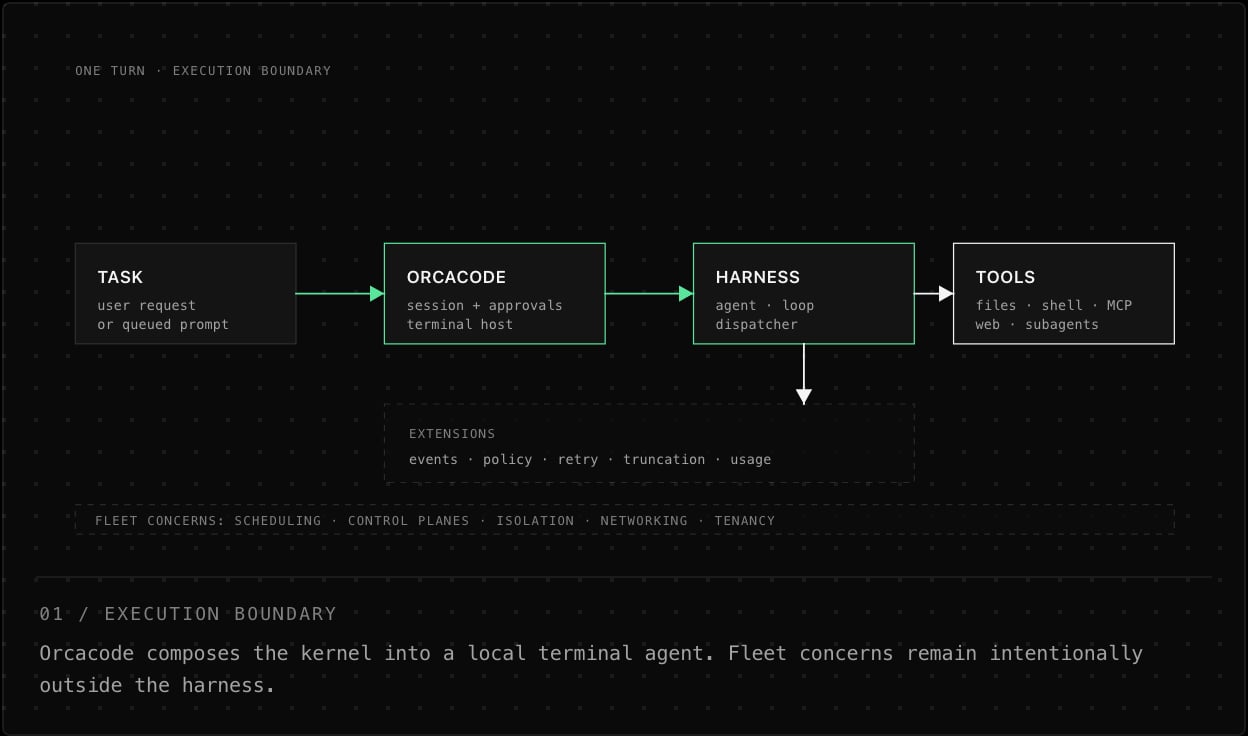
> Orca Harness owns the short path from a model response to correctly ordered tool results. Orcacode is the composition layer that turns that kernel into a local terminal agent.
## The execution boundary
The harness owns agent configuration, context, model invocation, the agent loop, tool dispatch, concurrent execution, cancellation, deadlines, limits, tool-call/result pairing, deterministic result ordering, and the extension lifecycle. The core kernel leaves session persistence to its host; the optional extensions crate provides JSONL transcript storage, and the Rust SDK offers persistent sessions. Fleet-scale scheduling, microVM lifecycle, networking, tenancy, and control-plane APIs remain outside this local execution stack.
 ## Runtime pieces
| Crate / layer | Responsibility |
| - | - |
| `harness-core` | The agent contracts, loop, dispatcher, limits, and test primitives. |
| `provider-auth` | Provider-neutral credential contracts. |
| `model-providers` | Anthropic, OpenAI-compatible, OpenRouter, Codex, Vercel AI Gateway, and CheaperInference model adapters. |
| `tools` | Workspace files, shell/processes, Python compute, subagents, workflows, and questions. A Bun REPL is included but currently broken on recent Bun: `bun-repl` refuses piped stdin. |
| `tool-extensions` | Optional MCP, skills, and web integrations. |
| `extensions` | Events, policy, compaction, truncation, retry, usage, and optional JSONL session persistence. |
| `sdk` | Session APIs, including optional disk-backed sessions and background work. |
| `orcacode` | The composition root: terminal UI, approvals, configuration, and runtime wiring. |
The dependency direction is intentional: tools and extensions depend on the core contracts; the core does not depend on an individual provider, tool, terminal UI, or control plane.
In SDK sessions, subagents, workflows, and processes share session-owned lifetimes. Typed host operations and model tools use the same underlying services; see [subagents](/orcacode/subagents#run-workers-in-the-background) and [the tool reference](/orcacode/tool-reference#execution-and-compute) for usage.
## One turn
1. The host builds a context from the session, instructions, mode, and active capabilities.
2. The model emits text and, when needed, one or more tool calls.
3. The dispatcher classifies calls, applies policy and approvals, then executes eligible calls concurrently.
4. Results return to the model paired to the original call IDs and ordered by call position, even when execution completes out of order.
5. Extensions observe or alter defined lifecycle seams without becoming part of the core loop.
This documentation is built and hosted on [Mintlify](https://mintlify.com), a developer documentation platform.
## Runtime pieces
| Crate / layer | Responsibility |
| - | - |
| `harness-core` | The agent contracts, loop, dispatcher, limits, and test primitives. |
| `provider-auth` | Provider-neutral credential contracts. |
| `model-providers` | Anthropic, OpenAI-compatible, OpenRouter, Codex, Vercel AI Gateway, and CheaperInference model adapters. |
| `tools` | Workspace files, shell/processes, Python compute, subagents, workflows, and questions. A Bun REPL is included but currently broken on recent Bun: `bun-repl` refuses piped stdin. |
| `tool-extensions` | Optional MCP, skills, and web integrations. |
| `extensions` | Events, policy, compaction, truncation, retry, usage, and optional JSONL session persistence. |
| `sdk` | Session APIs, including optional disk-backed sessions and background work. |
| `orcacode` | The composition root: terminal UI, approvals, configuration, and runtime wiring. |
The dependency direction is intentional: tools and extensions depend on the core contracts; the core does not depend on an individual provider, tool, terminal UI, or control plane.
In SDK sessions, subagents, workflows, and processes share session-owned lifetimes. Typed host operations and model tools use the same underlying services; see [subagents](/orcacode/subagents#run-workers-in-the-background) and [the tool reference](/orcacode/tool-reference#execution-and-compute) for usage.
## One turn
1. The host builds a context from the session, instructions, mode, and active capabilities.
2. The model emits text and, when needed, one or more tool calls.
3. The dispatcher classifies calls, applies policy and approvals, then executes eligible calls concurrently.
4. Results return to the model paired to the original call IDs and ordered by call position, even when execution completes out of order.
5. Extensions observe or alter defined lifecycle seams without becoming part of the core loop.
This documentation is built and hosted on [Mintlify](https://mintlify.com), a developer documentation platform.